THE SAMOYED THROUGH THE DECADES. Part 7: Underneath All That Fluff, Structure, Movement and Coat — The Architecture of a Working Dog
A Working Dog Was Never Meant to Be Just Pretty
There is something rather deceptive about a Samoyed. You look at one and see a beautiful white cloud, complete with a permanent smile, a luxurious coat and an expression that suggests it has never had a single unpleasant thought in its life.
Then you bring home your first one, discover that the cloud has opinions, considerable physical strength, and an uncanny ability to cover an entire house in white hair, and you begin to appreciate that there is considerably more to this breed than its appearance.
Beneath all that magnificent fluff lies something far more important: a carefully developed working dog.
In our previous articles, we explored the Samoyed's Arctic origins, its working heritage, the dogs that helped establish the breed, and the transition from an indispensable companion of northern communities to an internationally recognized show dog. Now it is time to examine the actual dog: structure, proportions, movement and coat — and why these characteristics matter far more than their contribution to a beautiful photograph.
The Samoyed did not develop its physical characteristics to impress a judge standing beside a show ring. Its construction was shaped by necessity. For generations, these dogs worked in demanding environments, accompanying people through harsh northern conditions. They helped with reindeer, guarded settlements, pulled sledges and remained close companions to their human families.
They needed sufficient strength to pull, endurance to travel, sound feet to negotiate difficult terrain and a coat capable of protecting them from severe weather. A dog that looked magnificent but could not perform its work would have had little practical value.
Beauty and functionality were never supposed to be competing qualities. The original dog needed both.
Proportions: Finding the Happy Medium
One of the most interesting observations in Hutchinson's Dog Encyclopaedia of 1935 appears in its discussion of the Samoyed's body. The author cautions against a dog that is too long in the back, but also against one that is excessively compact or cobby. The comparison is pointed: a body resembling that of a Chow Chow would put the Samoyed at a disadvantage as a draught dog.
Instead, the historical description advocates a happy medium: a muscular body, deep chest, well-sprung ribs, strong neck, straight front and strong loins.
The modern Canadian Kennel Club standard retains this general structural philosophy. It describes a muscular, moderate dog with a deep chest, well-sprung ribs and strong loins, and gives a more precise ideal body-length proportion. The standard also makes clear that substantial bone must not compromise speed and agility.
The language has become more anatomically specific, but the central idea remains recognizable: strength without clumsiness, substance without loss of mobility, and balance rather than exaggeration.
The objective was never to produce the largest, heaviest or most heavily coated dog possible. It was to produce a balanced animal capable of doing its job.
The Front End: Where Movement Begins
A strong and correctly constructed front assembly is essential in a working dog. The shoulders, upper arms, elbows and forelegs must work together to allow the dog to move freely and efficiently.
Hutchinson's historical description emphasizes a straight front and good bone. The modern CKC standard goes further, describing shoulder placement, upper-arm angulation, elbow position and pasterns. These details matter because a dog cannot move efficiently if its parts are not working together.
A generous coat can make a dog appear wider, heavier or more substantial than it actually is, but it cannot correct an incorrectly assembled front. Part the hair, examine the structure and look at the dog standing naturally. The truth is usually hiding somewhere underneath the fluff.
The Hindquarters: Power and Propulsion
If the front assembly helps support and guide movement, the hindquarters provide much of the driving power. Hutchinson's 1935 description emphasizes well-developed hindquarters, bent stifles and strong muscular construction, and identifies cow hocks and incorrect stifle construction as serious faults.
The modern CKC standard retains this emphasis and describes the pelvis, upper thigh, lower thigh, hocks and stifle in greater anatomical detail. A working dog needs to push forward efficiently. The muscles and joints of the hindquarters must generate propulsion without compromising stability.
The historical authors understood that a Samoyed needed more than an impressive silhouette. It needed the machinery underneath it to work properly.
Feet: Small Details With Big Consequences
For a dog developed to work in northern conditions, the feet are anything but a minor detail. The 1935 description refers to feet that are long and slightly spread, with well-padded soles and hair between the toes. The modern CKC standard describes a hare-foot, arched toes, tough pads and protective hair between the toes.
The terminology has become more precise, but the functional emphasis remains. A sound foot provides support, stability and protection. Excessive hair does not make a poorly constructed foot correct. The underlying structure matters.
The Coat: Quality Over Quantity
The Samoyed's coat is one of its defining characteristics, but its original purpose was practical rather than decorative. Hutchinson describes a double coat with a dense, soft undercoat and a harsher outer coat that stands away from the body.
The modern CKC standard makes a particularly important point: coat quality is more important than quantity. It cautions against excessive length and a droopy coat. That distinction deserves attention. The standard does not ask for the dog with the most hair; it asks for the dog with the correct coat.
The undercoat provides insulation, while the outer coat helps protect the dog from the environment. Together, they form a natural protective system. A coat that looks impressive but lacks the correct texture or functional characteristics is not necessarily a better coat.
Anyone who has attempted to groom a Samoyed during a serious coat blow will understand that Nature was not being economical with the materials. Still, the objective should never be to breed a dog simply because it produces an impressive amount of hair. The objective is to preserve the correct coat.
Movement: The Truth Comes Out When the Dog Moves
A standing Samoyed can be an impressive sight. A beautifully presented dog, with ears alert, tail carried correctly and coat arranged to perfection, can make a wonderful photograph. But a photograph only tells us part of the story.
Movement reveals how the different parts of the dog's anatomy work together. Are the limbs moving efficiently? Does the dog maintain balance? Is there freedom of movement? Does the dog appear comfortable and coordinated?
The modern CKC standard describes smooth, seemingly effortless movement, with good reach in front and powerful drive behind. It explains the purpose: the dog should cover the greatest amount of ground with the fewest steps, expending the least energy possible.
Efficient movement is not about how spectacular a dog looks while circling the ring. It is about how effectively its body performs. Exaggerated movement is not automatically better movement. What matters is efficiency, balance and soundness.

| 
|
 | |
A Picture Is Worth a Thousand Words: The Samoyed Then and Now
Sometimes the best way to understand the evolution of a breed is to stop reading about it and simply look. Hutchinson's 1935 encyclopaedia gives us photographs of actual Samoyeds from that period, including dogs identified by name and, in several cases, breeder or owner.
The historical photographs show familiar characteristics: erect ears, a wedge-shaped head, a characteristic expression, a substantial double coat and a strong outline. They also show variation. Some dogs have a more clearly visible body outline; others appear fuller in coat or different in overall silhouette.
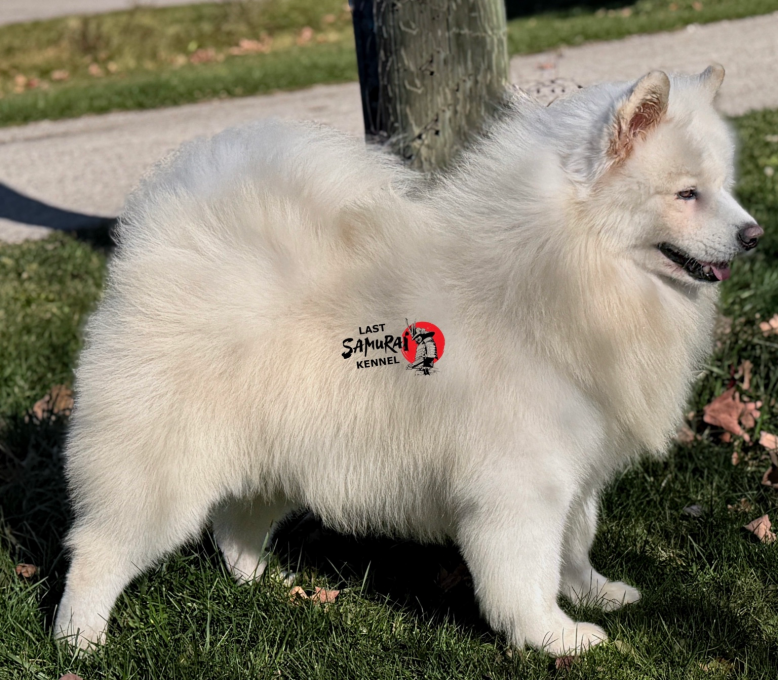
Our modern Last Samurai photographs add another perspective. Irvin is shown both in a natural outdoor pose and in show presentation. Panda is shown stacked and moving. Zoe's photographs were taken at approximately two years of age while she was out of coat — an important detail when considering her visible coat volume and outline.
The photographs of Juju and George in snow provide a different kind of context. They show the dogs in a natural winter setting, including a moment of play and movement. These are not conformation photographs, and they should not be used to judge precise structure. They do, however, help illustrate the breed's coat and its relationship with a cold-weather environment.
Today: Last Samurai Kennel
 Irvin — natural outdoor presentation |
 Irvin — conformation show presentation |
 Panda — standing show presentation |
 Panda — captured in motion |
 Zoe — approximately two years old; out of coat |
 Zoe — group presentation; approximately two years old and out of coat |
 Juju — natural winter presentation |
 Juju and George — playing and moving through snow |
 George — natural winter presentation | |
Comparing these images, it is tempting to say that modern Samoyeds simply have more coat or a more dramatic outline. In some modern show presentations, coat volume and grooming can create a fuller visual impression. But these particular photographs cannot establish a universal change across the breed, nor can they prove that modern dogs are structurally heavier or more exaggerated.
A generous ruff can make a neck appear fuller. Furnishings can make legs appear shorter. A carefully groomed coat can create an outline that differs from the construction underneath. Zoe's out-of-coat photographs are a useful reminder that coat condition and season can change the impression a dog makes.
The more responsible question is not whether the Samoyed of 1935 was better than the Samoyed of today. It is whether we continue to preserve the qualities that both generations were expected to possess: balance, soundness, a functional double coat and efficient movement.
The 1930s: Original Photographs from Hutchinson's Dog Encyclopaedia
 |
 |
 |
 |


Have We Improved the Breed, or Simply Changed Its Appearance?
After comparing Hutchinson's 1935 description with the modern CKC standard, one finding is encouraging: the fundamental structural philosophy has survived. Both emphasize a moderate, muscular body, deep chest, strong loin, developed hindquarters and a functional double coat.
The modern standard has become more anatomically detailed and more explicit about efficient movement and coat quality. It does not ask for the biggest coat or the most dramatic presentation. It asks for a balanced, functional Samoyed.
A breed standard describes an ideal; it cannot guarantee that every breeding decision, show entry or judging preference will perfectly reflect it. The challenge is to evaluate the whole dog. An impressive head cannot compensate for poor movement. An abundant coat cannot correct weak construction. A beautiful outline cannot replace soundness.
As breeders, we have a responsibility that extends beyond producing beautiful puppies. Every breeding decision influences what the Samoyed of tomorrow will look like, how it will move, how it will function and how closely it will retain the qualities that made the breed special.
When I look at a Samoyed, I want to see more than a beautiful coat and an attractive expression. I want correct proportions, sound construction, strong feet, well-developed muscles, effortless movement and a coat that serves its purpose.
I want to see a dog that can enjoy a show ring on Saturday and still be perfectly capable of accompanying its family on a long outdoor adventure on Sunday.
The Samoyed was never meant to be just a pretty face.
It was meant to be a capable, resilient and beautiful companion — all at the same time.
References and Image Credits
Historical primary source: Hutchinson's Dog Encyclopaedia (1935), Samoyed entry, supplied PDF. Photographic references include printed pages 1567, 1575, 1584, 1591 and 1592.
Modern breed reference: Canadian Kennel Club, Samoyed breed standard (effective January 2018).


Comments