THE SAMOYED THROUGH THE DECADES. Part 6:The Samoyed Personality, What We Should Never Lose
Updated: Nov 4
— ❄ —
There is something rather interesting about the Samoyed. You can spend years studying its construction, comparing pedigrees, examining movement, and trying to understand the finer points of coat quality. You can learn to recognize a good shoulder, a strong loin, a balanced outline and the difference between a coat that is correct and one that simply occupies a great deal of space.
And then the dog walks into the room, looks directly at you, makes a sound somewhere between a conversation and a formal complaint, and reminds you that none of those things explains what it is actually like to live with a Samoyed.
The breed’s famous smile is not entirely misleading. Samoyeds are generally social, expressive and deeply interested in the people around them. They are lively, intelligent, affectionate and often wonderfully entertaining. They can also be independent, persistent, vocal and remarkably inventive when they decide that your plans are not quite as sensible as their own.
That combination is part of their character.
The Samoyed was never simply a beautiful white dog developed to accompany a modern household. Its history is tied to people whose lives depended on their dogs. These animals worked, travelled, herded, guarded and lived in close contact with their human families. They needed to be capable of independent decisions, but they also needed to cooperate with the people whose lives they shared.
That balance — independence without detachment, confidence without aggression, friendliness without losing individuality — is one of the most important things we should understand about the Samoyed.
And it is something we should be very careful not to lose.
More Than a Pretty Face
The Samoyed’s relationship with people is not a recent development, nor is it simply the result of generations of selective breeding for a pleasant family companion.
Historical accounts describe the dogs living in close proximity to the Samoyedic people of northeastern Siberia. They were not kept at a distance as ornamental animals. They worked alongside their people and shared their living spaces. Some accounts describe dogs sleeping inside family shelters, close to their owners, where their thick coats were undoubtedly appreciated during long Arctic nights.
Their responsibilities were varied. Depending on the community and circumstances, dogs were used for sledding, herding, hunting and guarding. They were expected to be useful, adaptable and capable of living as part of a human community.
This close relationship matters when we consider temperament today.
A dog that lives and works alongside people must be able to read situations, respond to human communication and function as part of a group. It needs confidence, awareness and a certain degree of independence. It cannot be so timid that the world becomes overwhelming, nor so difficult to manage that cooperation becomes impossible.
The Samoyed’s social nature is deeply connected to this history.

The Canadian Kennel Club standard describes the breed as intelligent, gentle, loyal, adaptable, alert and full of action. It also emphasizes a friendly but conservative disposition, with shyness and distrustfulness considered undesirable. The FCI standard similarly describes the Samoyed as friendly, open, alert and lively, and states that the breed should never be shy or aggressive.
These are not merely pleasant words intended to make the breed sound attractive in a catalogue. They describe important elements of the character that made the Samoyed a successful working companion.
Of course, living in a modern home is not quite the same as travelling across the Arctic. Most of our dogs are unlikely to be asked to herd reindeer before breakfast. Their daily responsibilities now tend to involve supervising the kitchen, inspecting grocery bags and ensuring that no unattended sandwich is left without proper canine oversight.
Still, the underlying need for human connection has not disappeared.
A Samoyed is generally happiest when included in family life. It wants to know what is happening, where everyone is going and whether there is a possibility of participating. Being sent outside alone for hours is unlikely to satisfy a breed that was historically accustomed to living so closely with its people.
And if you happen to close a door between yourself and your Samoyed, do not be surprised if you receive a detailed explanation of why this arrangement is unacceptable.
An Independent Mind and a Cooperative Heart
One of the most misunderstood aspects of the Samoyed is its independence.
People often describe the breed as intelligent, and rightly so. But intelligence does not always translate into unquestioning obedience. In fact, the Samoyed can be an excellent example of why the two should not be confused.
A dog that has historically worked in demanding conditions cannot rely entirely on waiting for someone to tell it what to do. It needs to observe, assess and respond to its surroundings. That ability to think independently is part of the breed’s working heritage.
The Samoyed Club of America also discusses this independent nature in connection with the breed’s historical work, including herding reindeer. These dogs needed to make decisions while remaining connected to their human handlers.
This is where the Samoyed can become particularly entertaining for the modern owner.
You may give a perfectly reasonable instruction. Your Samoyed may understand it completely. It may even agree that the instruction is sensible.
But first, it would like to consider the matter.
There may be a pause. A look. Perhaps a small vocal contribution. Then, depending on the dog's opinion of the situation, you may receive the desired response — or a counterproposal.
This does not mean that the breed should be difficult to train or that poor manners should be excused as independence. A Samoyed still needs boundaries, education and consistent guidance. A cooperative temperament does not develop simply because we admire the breed’s intelligence.

The goal is not to produce a dog that blindly follows every command. It is to develop a dog that understands its people, trusts their guidance and is willing to work with them.
There is a difference between a dog that thinks for itself and a dog that has never learned that other members of the household are allowed to have opinions too.
Especially the human members.

The Famous Samoyed Smile
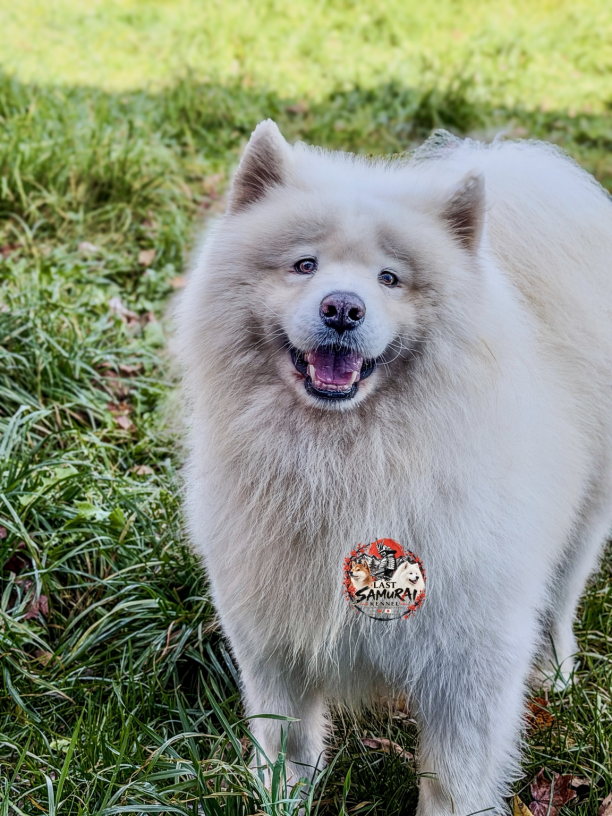
The Samoyed’s expression is one of its most recognizable features. The slightly upturned corners of the lips create the familiar smile that has become almost inseparable from the breed’s public image.
But the expression is only the beginning.
A good Samoyed temperament is generally friendly, open and approachable. These dogs are often interested in meeting people and participating in whatever activity is taking place around them. Many are naturally affectionate and enjoy attention from familiar people and strangers alike.
The breed standard does not, however, describe the Samoyed as a dog without individuality or boundaries. The CKC standard uses the phrase “friendly but conservative,” while the FCI standard emphasizes an open and friendly disposition.
That distinction is worth remembering.
Not every Samoyed will greet every person as a long-lost relative. Some are more reserved than others. Some are confident social butterflies; others prefer to observe before joining in. Some love children, some are perfectly comfortable around them but prefer a little personal space, and some would rather spend their afternoon with an adult who understands the importance of uninterrupted belly rubs.
All of these individual differences deserve to be understood.
Friendliness should not be confused with an obligation to enjoy every interaction. A sound temperament includes the ability to remain composed in different situations, to recover from unfamiliar experiences and to interact appropriately without becoming fearful or unnecessarily reactive.
We should also be careful not to confuse confidence with pushiness. A dog that enthusiastically launches itself into every person's personal space is not automatically better tempered than one that approaches politely.
And while we are on the subject, the famous Samoyed smile should never be used as evidence that a dog is happy in every situation. A photograph can capture a lovely expression. It cannot tell us everything about the animal standing behind it.
The real character of a Samoyed is seen over time — in how it behaves at home, how it responds to unfamiliar situations, how it interacts with people and animals, and how it handles everyday frustrations.
A smile is lovely. A stable temperament is much more important.

A Dog With Something to Say
Anyone who has lived with a Samoyed knows that silence is not necessarily its preferred method of communication.
Samoyeds can be vocal. They may bark, howl, grumble, whine, sing or produce a variety of sounds that are difficult to classify without consulting a specialist in canine conversation.
And sometimes, even then, the specialist would probably need a second opinion.
This expressive nature is part of what makes the breed so entertaining. Samoyeds often communicate their excitement, frustration, anticipation and general opinions with considerable enthusiasm.
They can be playful well into adulthood, curious about their surroundings and eager to participate in family activities. The Samoyed Club of America describes the breed as active, inquisitive, quick-witted and playful, with many dogs retaining their mischievous nature well beyond puppyhood.
That energy and playfulness should not be mistaken for an absence of maturity.
A well-adjusted adult Samoyed should be capable of settling down when appropriate. It should be able to enjoy activity without being permanently overstimulated, and it should be able to participate in family life without demanding that every moment become an organized entertainment programme.
Although, in fairness, some Samoyeds appear to believe that the household entertainment programme should be managed by them.
Their alertness also deserves attention. Samoyeds are generally aware of their surroundings and often quick to notice changes. They may announce visitors, unfamiliar sounds or suspicious activity outside the window.
Whether the suspicious activity is an actual intruder or a leaf moving in a particularly questionable manner is sometimes open to interpretation.
The important distinction is that alertness should not become excessive reactivity. A dog that notices the world around it is desirable. A dog that cannot relax because the world continues to exist is a different matter.

What Temperament Should Look Like Today
Modern life has changed the responsibilities we ask of our Samoyeds, but it has not removed the importance of their original character.
Today, most Samoyeds live as family companions. They may participate in conformation shows, dog sports, hiking, recreational sledding and other activities. They may spend their days accompanying their owners to work, travelling in cars or supervising children doing homework.
Their environment is different, but their need for appropriate social interaction, mental stimulation and consistent guidance remains.
When evaluating temperament, I believe it is important to look beyond the first impression.
A confident dog is not necessarily a loud dog. A friendly dog does not need to demand attention from every person it meets. An independent dog should still be responsive to its handler. An energetic dog should be capable of settling.
Likewise, a reserved dog should not automatically be labelled unsound, provided that its behaviour is appropriate to the situation and does not reflect fearfulness or distrust.
The breed standard gives us a description of the desired temperament, but it does not promise that every individual will have an identical personality. Dogs are living animals, not products manufactured to identical specifications. Genetics, early development, social experiences, training and the environment all contribute to the adult dog we eventually see.
This is why temperament assessment should never be reduced to a single moment.
A puppy that is shy during one visit may simply need time to become comfortable. A puppy that immediately climbs into someone's lap may be outgoing, or it may simply have discovered that laps are excellent places to investigate pockets.
We need to observe behaviour over time and in different circumstances.

For breeders, this responsibility begins long before puppies leave for their new homes. It involves thoughtful selection of breeding dogs, honest evaluation of their temperaments, appropriate raising and socialization of puppies, and a willingness to recognize weaknesses rather than explain everything away as a charming breed characteristic.
Not every undesirable behaviour is a breed trait. And not every difficult behaviour should be excused with the phrase, “Well, that's just a Samoyed.”
Sometimes it is simply a training issue. Sometimes it reflects an unsuitable environment. And sometimes it deserves a much closer look at the breeding behind the dog.
What Breeders Must Never Lose
When we talk about preserving a breed, the conversation often turns naturally to structure, coat, movement, health testing and pedigrees.
These are all essential. They deserve serious attention and careful evaluation.
But temperament must stand beside them.
A Samoyed can have a beautiful head, excellent proportions, correct movement and an impressive pedigree. It can be wonderfully presented in the show ring and photograph like a dream.
But if the dog is chronically fearful, unstable, unnecessarily aggressive or unable to function comfortably in ordinary situations, something important has been lost.
A breed is not preserved simply by reproducing its appearance.
The Samoyed's traditional character — its friendliness, confidence, intelligence, adaptability and close relationship with people — is part of its heritage. These qualities should receive the same thoughtful consideration as the physical characteristics described in the breed standard.
This does not mean that every breeding dog must have an identical personality. We should preserve individuality, too. There is room within the breed for the quieter observer, the enthusiastic social butterfly, the serious working dog and the resident household comedian.
What matters is that these different personalities are built on a sound foundation.
As breeders, we need to ask ourselves more than whether a dog is beautiful enough to reproduce. We should also ask whether we genuinely want its temperament represented in the next generation.
Would we be happy to live with several dogs carrying the same characteristics? Would we be comfortable seeing those traits passed on to families who may be experiencing the breed for the first time? Are we selecting for stable, confident and socially appropriate dogs, or are we allowing an attractive appearance to distract us from weaknesses that deserve attention?
These are not always easy questions. But responsible breeding rarely comes with a convenient answer key.
And sometimes the most valuable decision a breeder can make is the decision not to breed a particular dog.
The Samoyed We Should Remember
The Samoyed has travelled a remarkable distance from its northern origins to the modern show ring and family home.
Its appearance has been refined through generations of breeding. Its coat, structure and presentation have become subjects of careful study. We have learned to recognize the details that distinguish a good Samoyed from a merely fluffy white dog.
But underneath that coat, the character should still be recognizable.
We should still have a dog that enjoys being part of human life. A dog with enough intelligence to think, enough independence to be interesting and enough cooperation to make living together enjoyable. A dog that is generally friendly, confident and adaptable, without losing the individual personality that makes each Samoyed different.
We should preserve the dog that can work, play, explore, communicate and settle beside its people.
The dog that will happily accompany us on an adventure, then return home and insist that the sofa was always the main objective.
And yes, the dog that occasionally argues with us about absolutely nothing — although, according to the dog, the matter is extremely important.
The famous Samoyed smile is worth preserving. But the temperament behind it is worth far more.
Because the Samoyed was never meant to be just a beautiful dog.
It was meant to be a good dog to live and work alongside.
And that is the part of the breed's heritage we should never lose.
LAST SAMURAI KENNEL
Preserving the breed, one generation at a time.
Sources & Further Reading
Canadian Kennel Club. Samoyed Breed Standard.
Fédération Cynologique Internationale. FCI Standard No. 212: Samoyed.
Swedish Kennel Club / Nordic Kennel Union. Samoyed breed history and characteristics.
American Kennel Club. Samoyed history and breed background.
Samoyed Club of America. Temperament and breed information.


Comments