THE SAMOYED THROUGH THE DECADES. Part 5: From Arctic Camp to Show Ring.
A historical look at how the Samoyed became a recognized show breed—and why the working dog still matters.
There is a moment in the history of many working breeds when the world begins to look at them differently. The dog that once earned its place through usefulness is suddenly being assessed beneath bright lights, on polished floors, and by people holding scorecards. The Samoyed made that journey too.
It is tempting to imagine a clean transformation: first the Arctic sled dog, then the elegant show dog. History is rarely that tidy. The Samoyed did not stop being a working dog when it entered the show ring. Nor did a written standard suddenly create the breed. What changed was the way people organized, described, bred, registered, and judged dogs that had already been shaped by generations of life in the North.
For breeders today, that distinction matters. A show ring can help us compare dogs and preserve a recognizable type. It can also tempt us to mistake presentation for quality. The challenge has always been to keep the whole dog in view.
When the working dog became a recognized breed
By the late nineteenth century, European explorers and travellers had brought northern dogs into wider public view. Some were acquired during expeditions; others were purchased or obtained through contacts in northern Russia and Siberia. A small number eventually reached Britain, where Ernest and Clara Kilburn-Scott became central figures in the early development of the Samoyed as an organized breed.

The dogs that arrived in Europe were not products of a modern kennel system. They came from working communities and varied in appearance. White, biscuit, cream, and darker dogs were part of the historical picture. Their value was not determined by a fashionable outline or an impressive coat presentation. They had to live and work in demanding conditions.
As interest grew, fanciers began to gather, compare, and breed these dogs more deliberately. The transition from a population of northern working dogs to a formally recognized breed was not a single event. It was a gradual process involving imports, early breeders, clubs, written descriptions, and kennel registration.

From expedition companion to breeding foundation
The early British foundation story is closely associated with the Kilburn-Scotts and with dogs brought back by explorers. Sabarka, Whitey Petchora, and Musti are among the names that recur in accounts of the breed's beginnings in Britain. Their importance is historical as well as genealogical: they represent the small and unusual group from which organized Western breeding began.
The story also reminds us how easily later retellings can become more certain than the surviving evidence. Some dogs travelled through several hands, and not every photograph or anecdote carries a reliable identification. A famous name attached to an attractive old photograph is not proof. Where the record is incomplete, it is better to say so than to give a dog an identity it may never have had.
The American story developed along a related but distinct path. Moustan of Argentau, brought to the United States by Rosalie Mercy d'Argentau, is recorded as the first Samoyed registered by the American Kennel Club in 1906. That date is an American registration milestone; it should not be confused with the later formal recognition and organization of the breed in Britain.
The first standards: putting the Samoyed into words
A breed standard is an attempt to describe an ideal—not a claim that every dog in the founding population already looked identical. Early standards gave breeders and judges a shared language for discussing size, proportion, coat, colour, head, expression, movement, and temperament.

There were two early standard-setting milestones, and they should not be collapsed into one. The Swedish Kennel Club and Norwegian Kennel Club collaborated on a Nordic Samoyed standard in 1908. In England, the first breed standard was established in 1909; the Samoyede Club was founded that year, and the standard was published in the contemporary press in May 1909. The English Kennel Club’s formal recognition followed in 1912. English registration records predate that recognition: Samoyeds were initially listed among foreign dogs, and a separate register began in June 1912. These were related developments, but distinct national milestones.
The standard mattered because it made comparison possible across kennels and countries. But standards are living documents, interpreted by people. Their wording can guide selection; it cannot replace sound judgment, knowledge of pedigrees, or an understanding of what the dog was built to do.
The show ring arrives
Once organized breeding and exhibition took hold, the Samoyed began to acquire a more consistent public identity. Breeders could compare their dogs with those from other kennels. Judges could reward the dogs they believed best represented the written ideal. Registration records made ancestry easier to trace, and clubs created a place for people interested in the breed to exchange knowledge.

The show ring brought real benefits. It encouraged breeders to study construction, movement, coat, expression, and balance. It gave the public a chance to see the breed and helped establish a community around its preservation. It also created a shared reference point: a dog could be assessed against a standard rather than simply against the preferences of its owner.
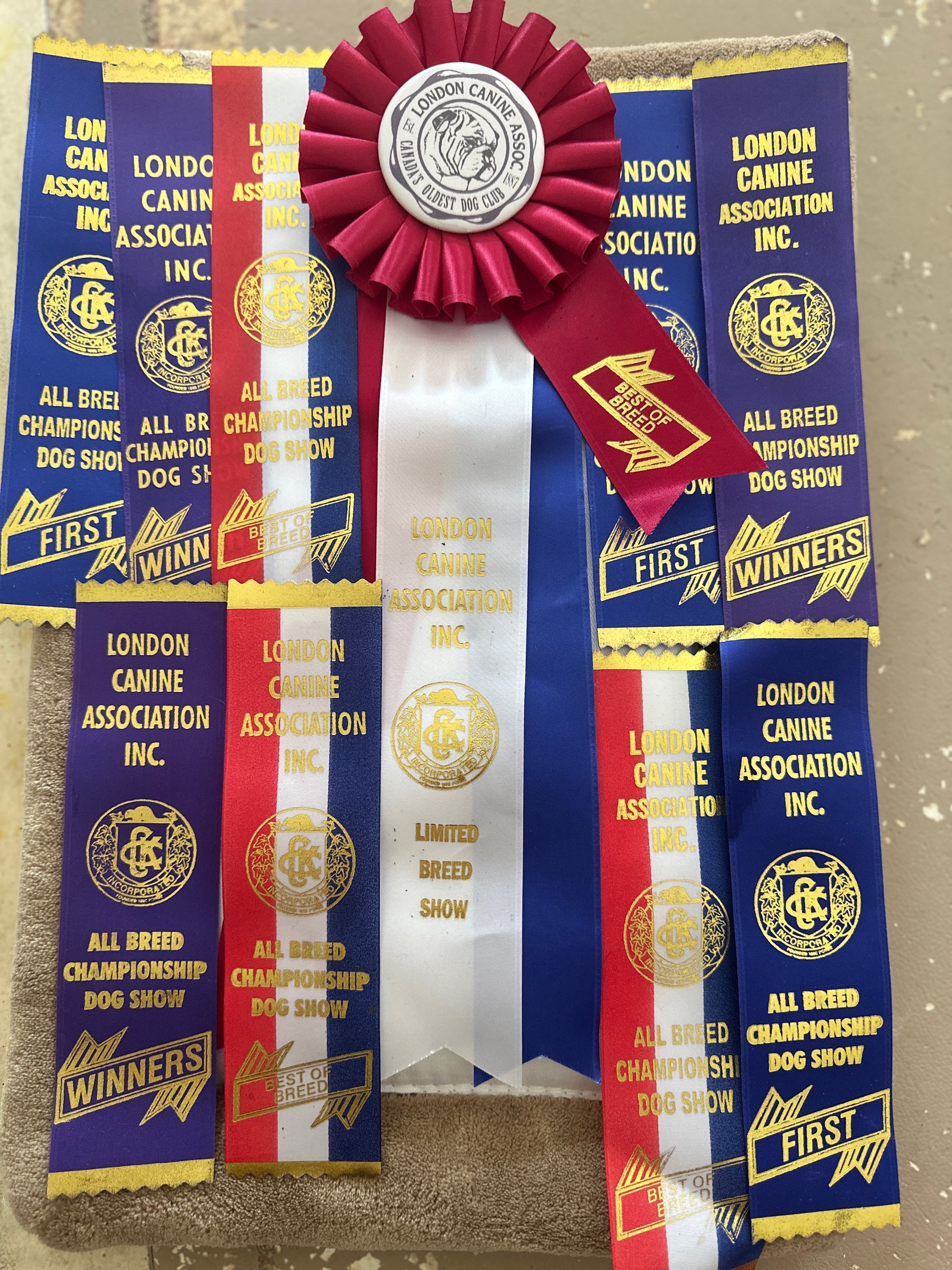
But a show result is a snapshot. It tells us how a dog was assessed on a particular day, under a particular judge, against the competition present. It does not, by itself, tell us whether that dog is healthy, fertile, long-lived, genetically valuable, easy to live with, or capable of sustained work. A title can be an achievement. It is not a complete breeding evaluation.

Across the Atlantic: the American Samoyed
In the United States, the first AKC registration in 1906 gave the breed an early foothold. The Samoyed Club of America was founded in 1923 and became the AKC parent club. American breeding developed through imports and the work of dedicated kennels, with a particularly important expansion after the First World War. The Samoyed Club of America notes that many present-day American Samoyeds trace their ancestry to dogs imported during the post-war period.
Kennels such as Greenacre, Snowland, and White Way appear in accounts of the breed's early American development. Their breeders helped establish the Samoyed beyond a small circle of imported dogs and enthusiasts. The work was not simply to produce attractive show entries; it was to build a viable population and preserve a recognizable breed.
The British and American histories are connected, but they are not interchangeable. Registration systems, club histories, imported dogs, and the development of particular kennel lines need to be kept distinct. That matters when we talk about pedigrees today: a date in one country's register does not automatically mark the same milestone in another.

A breed shaped by more than one country
As the breed spread, national kennel clubs and breeders influenced how the Samoyed was described and selected. Different countries developed their own registration histories and judging traditions, while exchanging dogs and bloodlines. The result was not a simple straight line from one kennel to another, but a network of people making choices across generations.
This is one reason historical photographs and pedigrees deserve careful handling. A photograph can show us what a dog looked like, but without a date, name, breeder, and source, it cannot tell us where that dog sits in the breed's history. A pedigree can show relationships, but it does not reveal the whole animal: its movement, temperament, health, or working ability.
The most useful historical record combines both: photographs tied to reliable captions, written pedigrees, registration documents, kennel records, and the observations of people who knew the dogs.
Did the show ring change the Samoyed?
Of course it did. Organized selection always changes a population. Once breeders begin choosing dogs partly for how closely they match a written standard, the characteristics emphasized by that standard become more influential. Exhibition rewards can also affect what breeders notice, what buyers ask for, and which dogs are used more often.
That is not automatically a problem. A breed standard can protect type and discourage extremes. The Samoyed Club of America's standard describes the Samoyed as essentially a working dog and emphasizes strength, agility, dignity, grace, balance, and movement. It also cautions that coat quality matters more than coat quantity. Those are useful reminders that the dog should never disappear beneath the presentation.
The risk comes when one visible feature begins to dominate selection. More coat is not necessarily better coat. More substance is not necessarily better construction. A dramatic head, a fashionable outline, or a string of titles cannot compensate for unsound movement, poor health, unstable temperament, or a loss of functional ability.
A Samoyed should be beautiful, certainly. There is no need to pretend otherwise; most of us noticed the breed because of that unmistakable white smile in the first place. But beauty should be the expression of a well-made, healthy, capable dog—not a substitute for one.
The breeder's responsibility
For those of us breeding Samoyeds today, the show ring is a tool. It can provide an informed outside opinion, expose us to different lines, and help us evaluate how our dogs compare with the written standard. It is not the final authority on whether a mating was worthwhile or whether a dog should contribute to the next generation.
We have to look beyond the ribbon. We need to consider health testing, longevity, temperament, sound structure, movement, genetic diversity, and the qualities that make the Samoyed a practical, adaptable working companion. We also need to understand what our pedigrees contain—not just the titles printed beside the names.
The question is not whether the Samoyed should be shown. The show ring has played an important role in the breed's history and can continue to do so. The question is whether we use it in service of the breed, or allow the breed to become shaped primarily in service of the show ring.
The difference is significant. One approach preserves a dog. The other risks preserving only an image of one.
From the Arctic camp to today
The Samoyed's journey into organized breeding and the show ring gave the breed visibility, structure, and an international community. It also placed a responsibility on every generation of breeders: to remember what came before the standards, the titles, and the polished photographs.
The dogs that first travelled west were valued because they could work, adapt, endure, and live closely with people. Those qualities did not become less important when the breed entered the show ring. If anything, they became easier to overlook.
At Last Samurai Kennel, we believe the show ring should help us recognize quality—not redefine it for convenience. A Samoyed should still be balanced, sound, athletic, healthy, and pleasant to live with. The coat may catch the light, but the dog underneath it must remain the priority.
Because underneath all that fluff, there should still be a very good dog. Preferably one that can get off the sofa without assistance.
Last Samurai Kennel
Preserving the breed, one generation at a time.
Historical References
· American Kennel Club — “Samoyed History: From Nomadic Hunters to Fluffy Friends.”https://www.akc.org/expert-advice/dog-breeds/samoyed-history/
· Samoyed Club of America — “Breed Origin and History.”https://www.samoyedclubofamerica.org/the-samoyed/in-depth/breed-origin-and-history/
· Samoyed Club of America — “AKC Standard.”https://www.samoyedclubofamerica.org/the-samoyed/in-depth/akc-standard/
· Swedish Kennel Club / Nordic Kennel Union — Samoyed breed history.https://www.skk.se/en/nku-home/nordic-dog-breeds/samoyed/
· American Kennel Club — Breeds by year recognized.https://www.akc.org/press-center/articles-resources/facts-and-stats/breeds-year-recognized/
· Canadian Kennel Club — “Meet the Samoyed.”https://www.ckc.ca/en/The-Dish/March-2020/Meet-the-Samoyed
· FCI Standard No. 212 — Samoyed; historical note on the first English standard.https://fci.be/Nomenclature/Standards/212g05-en.pdf
· The Samoyed Club Inc. (New Zealand) — Sleigh Courier, Autumn 2009 and Autumn 2010; historical chronology and standard comparison.https://www.thesamoyedclub.org.nz/pdfs/sleighcourier2009autumn.pdf
· The Samoyede Club / contemporary standard text, reproduced from The Queen, 15 May 1909.https://www.koraal.com/pages/samoyed%20standard.htm
· Rex of White Way Samoyed Memorial Library & Museum — historical White Way materials.https://www.rexofwhiteway.com/
· Hutchinson’s Dog Encyclopaedia (1935), Samoyed entry, pp. 1564–1591; additional breed photographs through p. 1600.https://www.samoyed.org/hutchinson/
P


Comments